 Dossier

How Booking.com's virtue signaling hurts real victims
Booking.com is an online travel platform owned by Booking Holdings. The Next White building is listed on it as “Next White Aparthotel OFFICIAL”.
Booking.com's values say that it “does not tolerate theft, vandalism, criminal activity or extortion”, and that illegal activity may lead to a property being blocked. Its community standards require partners to act lawfully. In its standard contract for accommodations, the General Delivery Terms, the accommodation warrants that it complies with the laws of the jurisdiction where the property is located in all material respects regarding products and services (Clause 5.2(iv)).
For those who report a breach, the Human Rights Statement of Booking Holdings, linked from Booking.com's pages, counts the communities in which it operates among its stakeholders, invites external stakeholders to use its Compliance Helpline, and states twice: “All reports are thoroughly investigated, and action is taken where appropriate”. It has the following image on its first page.

Additionally, the Supplier Code of Conduct names the same helpline as the channel through which stakeholders, members of the community among them, may raise concerns about a supplier that has no proper channel of its own. Booking.com's enforcement page says “We assess each report on a case-by-case basis and take appropriate action” and lists what can be done to a partner: notify it of the reported concern, warn it, suspend its listing or terminate it. The General Delivery Terms give the same powers by contract. Booking.com may suspend or terminate an accommodation upon “a serious complaint from one or more Guests or a third party” (Clause 7.4(vii)), to protect the property of third parties and prevent unlawful behaviour (Clause 7.4(xv)), or when it reasonably believes that the accommodation has breached its warranty of compliance with the law (Clause 7.4(xvi)).
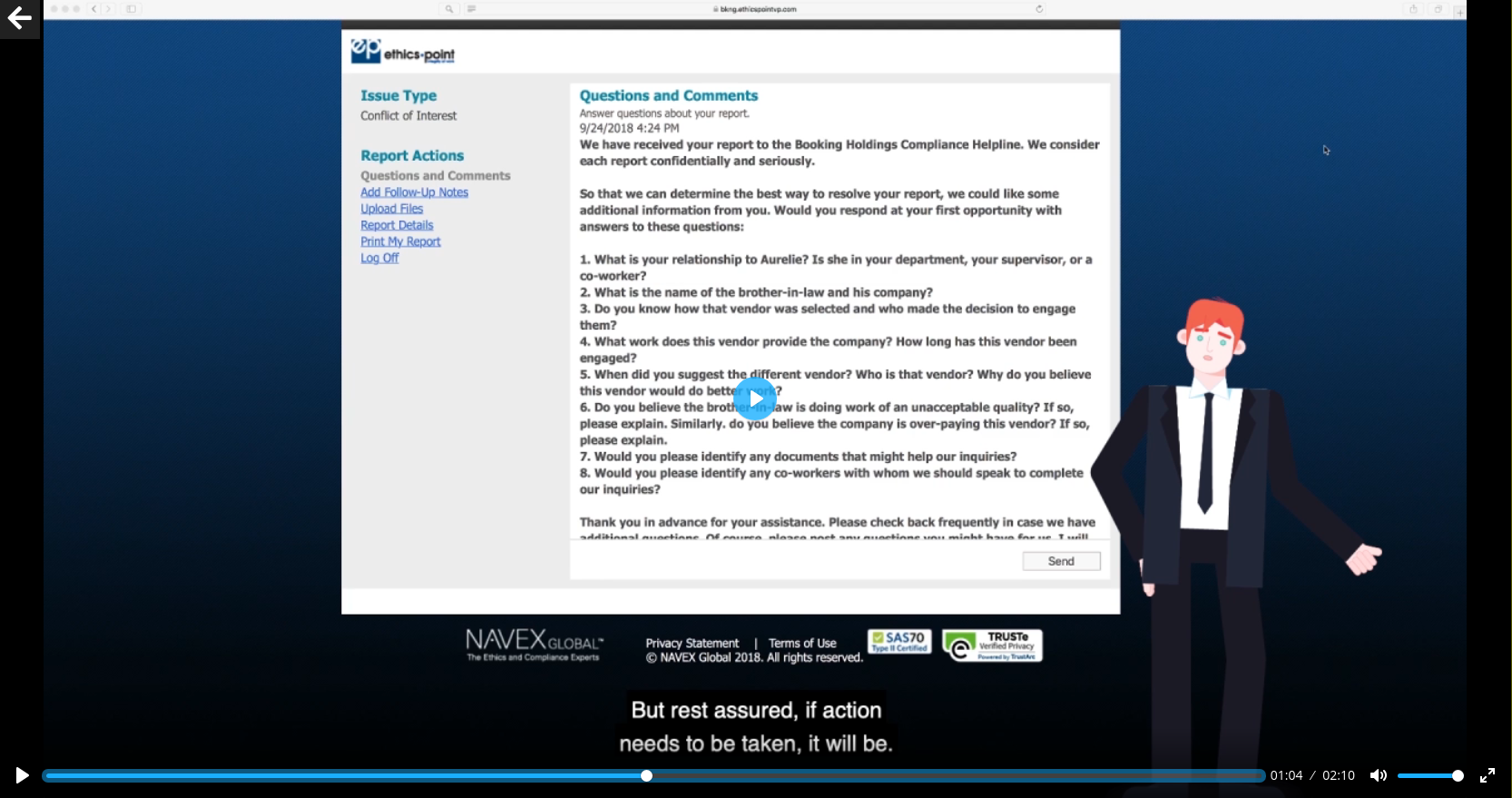
The fine print is narrower. The two newer codes, the Supplier Code of Conduct (2025) and the Code of Conduct (2026), promise only a review, with an investigation if Booking.com judges one appropriate. Every measure against a partner is optional. And the Code of Conduct and the three Booking.com pages each say that they create no rights.
On November 7, 2026, I filed a report on the Compliance Helpline, as an affected owner, under the Human Rights Statement and the stakeholder provision of the Supplier Code of Conduct. It described the exclusion from the elevators and the waiver of claims and payments it is used to extract, as well as the falsified documents I refused to sign and how signatures on them were sought, with links to this dossier, and it asked two questions: whether Booking.com's standards apply to a partner's conduct towards the owners of the apartments in a building it lists, and whether the conduct described breaches them. The full exchange is published here.
The helpline acknowledged the report on November 9. The next day, it wrote that its programme addresses possible violations of the Code of Conduct by employees, said it would pass the information to a management team at Booking.com, and asked how I had learned of the helpline. On November 12, it closed the matter: according to it, it was not within its jurisdiction to get involved in matters involving “non-accommodation partners or non-travelers”, and I should resolve it with “the property owner” directly, involving local law enforcement as needed. On the same day I asked for the report to be escalated and put three further questions: whether it had been assessed against the Human Rights Statement and Clause 7.4, whether the partner had been asked to comment, and who was responsible for the decision. On November 13, Booking.com Customer Service wrote that this was a dispute between me and the property operator, that they were “unable to intervene”, and that I should contact the company restricting the access. As of November 21, 2026, none of my five questions has been answered.
Each reason I was given is contradicted by a document that Booking.com publishes:
- The helpline said that its programme concerns employees. Both the Human Rights Statement and the Supplier Code of Conduct send members of the community there.
- The helpline declined because the matter involved “non-accommodation partners or non-travelers”. The phrase can be read in two ways. If it means that Next is not an accommodation partner, the building's listing says otherwise. If it means that I am neither a partner nor a traveler, the contract names a complaint from a third party as a ground to act, and both the statement and the code of conduct count communities among their stakeholders.
- The statement says that all reports are thoroughly investigated. Mine was closed in five days on a question of jurisdiction; the substance was not addressed. The only direct question I was asked was how I had learned of the helpline.
- Customer Service said that Booking.com was unable to intervene. The enforcement page and Clause 7.4 list what it is able to do, the least of which is to tell the partner that a concern was reported. I had asked whether that was done. Booking.com was perfectly able to act.
Both replies sent me back to Next or to the authorities. The report itself says that Next's director stopped answering in August and that no authority has engaged with the substance in four months. None of this is a breach of an obligation towards me, since the documents are written so that I have no claim on them. What it shows is that Booking.com does not apply what it publishes.
On the pages a customer reads, Booking.com does not tolerate criminal activity, expects its partners to respect human rights and investigates every report. When the crimes Next has committed against me were reported to it, every measure turned out to be optional and the helpline turned out to be for employees. The answer I received was a rule being applied, not a judgment on my case, and in my view the rule exists because looking into what partners do to people who are neither guests nor partners costs money and earns none. Besides the hypocritical virtue-signaling, what I object to is being invited to report, at the cost of the work it takes to make a report accurate, by a company that had already decided not to address it.